
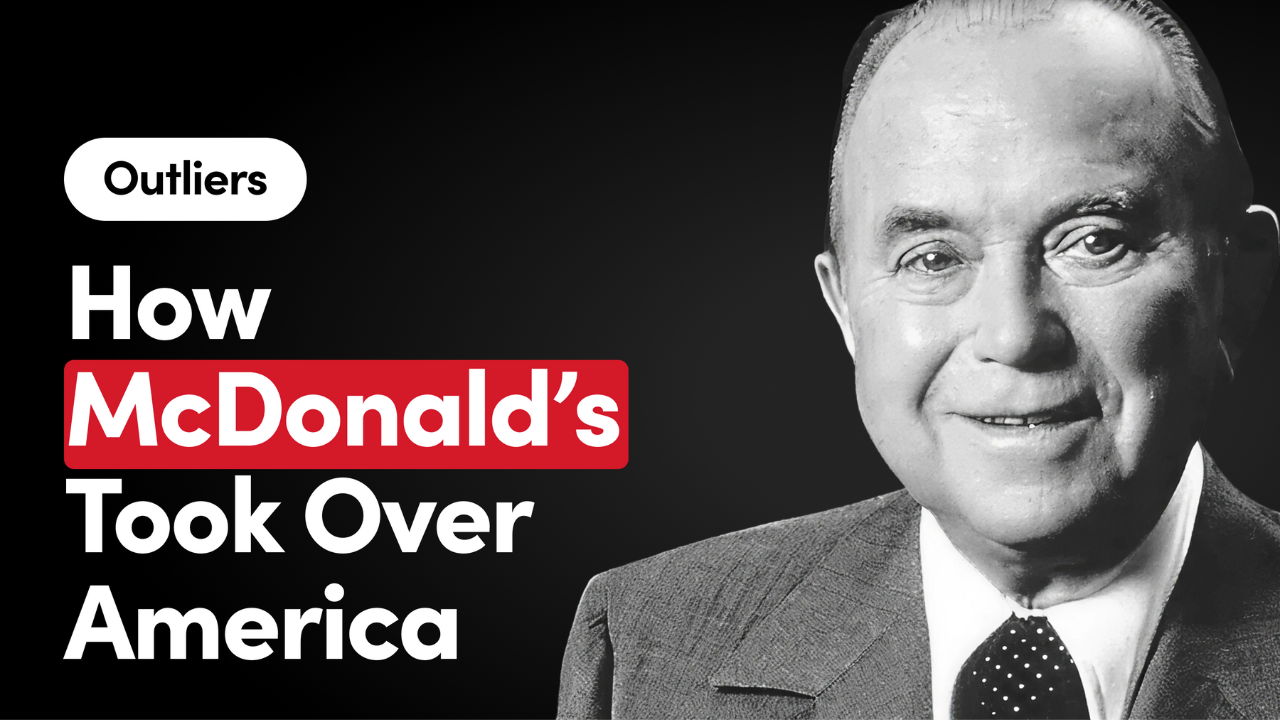
[Outliers] Ray Kroc: How McDonald’s Took Over America
Key Takeaways
Implement strict operational standards to ensure consistency and quality across all locations.
Leverage franchising as a means to scale quickly while aligning the interests of franchisees with corporate goals.
Invest in real estate to secure prime locations and create additional revenue streams.
The Genesis of McDonald's
Ray Kroc's journey to establishing McDonald's is a testament to the power of perseverance and vision. At the age of 52, after years of selling milkshake machines, Kroc opened the first McDonald's franchise in 1955. His prior experience in sales and understanding of operational efficiency laid the groundwork for what would become a global phenomenon. Kroc recognized the potential of the original McDonald brothers' restaurant, which emphasized speed, quality, and low prices. This foundational insight was crucial; it wasn't just about selling burgers, but about creating a system that could be replicated across various locations.
The Power of Standardization
One of Kroc's key innovations was the establishment of strict operational standards. He famously stated, "You must perfect every fundamental of your business if you expect it to perform well." This focus on perfection ensured that every McDonald's restaurant provided a consistent customer experience, which is vital in building brand loyalty. Kroc's insistence on uniformity in food preparation, service, and cleanliness not only enhanced customer satisfaction but also streamlined training processes for new employees. This standardization became a cornerstone of McDonald's operational strategy, allowing for rapid scaling without sacrificing quality.
Franchising as a Growth Strategy
Kroc's franchising model was revolutionary in the fast-food industry. By allowing franchisees to operate under the McDonald's brand, Kroc could expand quickly without the financial burden of owning each location. He understood that "the best ideas don’t come from headquarters. They come from people close to the problem." This decentralized approach empowered franchisees, who were often more attuned to local market demands. Kroc's strategy of aligning the interests of franchisees with corporate goals ensured mutual growth, creating a robust network of motivated operators who contributed to the brand's success.
Real Estate: The Hidden Engine of Success
A less obvious but equally critical aspect of Kroc's strategy was his focus on real estate. Kroc understood that owning the land on which franchises operated provided significant leverage. By purchasing prime locations and leasing them to franchisees, McDonald's not only secured its market position but also generated a steady revenue stream. This strategy allowed McDonald's to maintain control over its brand and operations while minimizing risks associated with franchisee performance. Kroc's insight that "income can appear in many forms" highlights the multifaceted approach to revenue generation that has become a hallmark of McDonald's business model.
Why it matters
Kroc's strategies illustrate how operational excellence, strategic franchising, and real estate investment can drive sustainable growth in the fast-food industry. As competition intensifies, these principles remain relevant for businesses seeking to scale effectively.
Get your personalized feed
Trace curates the best articles, videos, and discussions based on your interests and role. Stop doom-scrolling, start learning.
Try Trace free