
Writing about Agentic Engineering Patterns
Key Takeaways
Implement test-driven development (TDD) to guide coding agents in generating reliable code.
Adopt incremental development practices to break tasks into smaller units for better management.
Establish regular feedback loops to review and test code generated by agents, ensuring quality and relevance.
The Problem
In the rapidly evolving landscape of software development, the integration of coding agents like Claude Code and OpenAI Codex presents a unique challenge. Traditional coding practices often rely on manual oversight and iterative feedback loops, which can slow down the development process. As the cost of generating initial working code diminishes, developers must rethink their strategies for collaboration and productivity. The central question arises: how do we leverage these tools effectively without compromising code quality or team dynamics?
The Approach
Agentic Engineering emerges as a solution, focusing on the use of coding agents to amplify the capabilities of professional software engineers. Unlike vibe coding, where non-programmers might generate code without understanding its structure, agentic engineering encourages a symbiotic relationship between human expertise and AI capabilities. This approach emphasizes structured coding practices that enhance the reliability and efficiency of code generation, enabling developers to produce high-quality software at an accelerated pace.
Implementation of Agentic Engineering Patterns
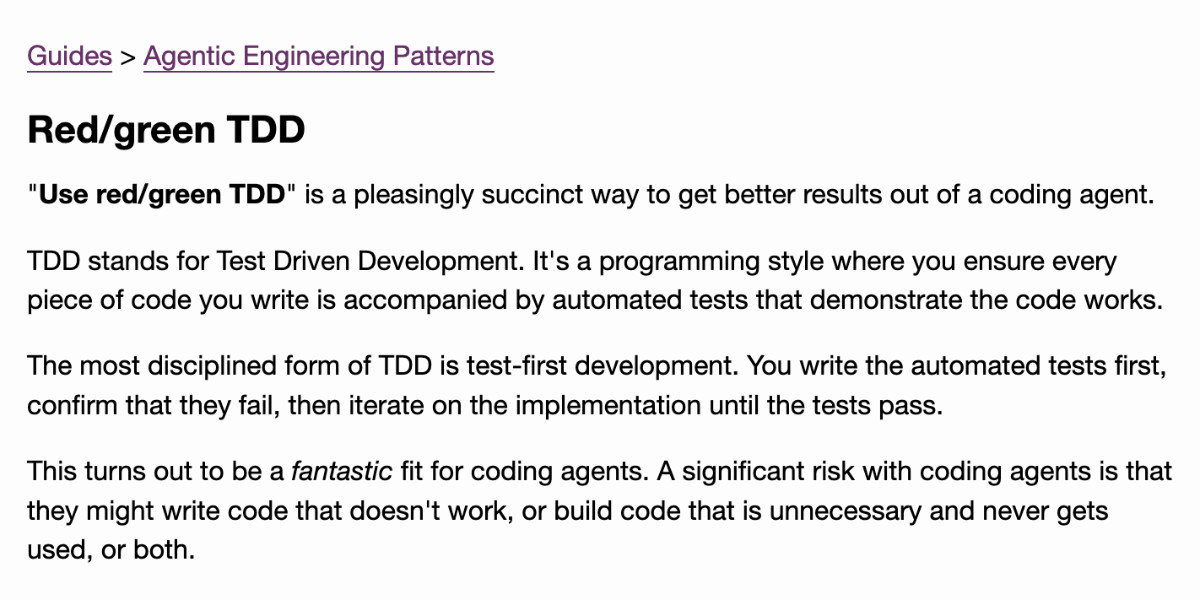
To implement agentic engineering patterns, developers should adopt practices such as test-driven development (TDD). By writing tests before code, engineers can guide coding agents to produce more succinct and reliable outputs. For instance, when using a coding agent, a developer might first define the expected behavior of a function through tests, allowing the agent to generate code that meets these specifications. This not only ensures that the code is functional but also reduces the need for extensive debugging later in the process.
Key Patterns in Agentic Engineering
- Red/Green TDD: Start with a failing test (red), write minimal code to pass the test (green), and refactor. This pattern helps agents focus on producing relevant code snippets that fulfill specific requirements.
- Incremental Development: Break down larger tasks into smaller, manageable units. This allows coding agents to tackle one piece at a time, improving clarity and reducing errors.
- Feedback Loops: Establish regular checkpoints where the code generated by agents is reviewed and tested. This practice not only maintains code quality but also provides insights into how agents can be better utilized.
Future Considerations and Continuous Learning
As the field of agentic engineering evolves, continuous learning will be crucial. Developers should stay updated on the latest advancements in AI-assisted programming and explore new coding patterns that emerge from ongoing research. Engaging with communities and resources, such as Simon Willison's blog and the ai-assisted-programming tag, can provide valuable insights and foster a culture of innovation within teams.
By embracing agentic engineering patterns, software engineers can enhance their productivity, improve code quality, and adapt to the changing dynamics of software development.
Why it matters
Embracing agentic engineering patterns not only enhances your coding efficiency but also positions you as a forward-thinking developer in a rapidly changing tech landscape. By mastering these techniques, you can significantly improve your team's output and your own career trajectory.
Get your personalized feed
Trace curates the best articles, videos, and discussions based on your interests and role. Stop doom-scrolling, start learning.
Try Trace free